Field Engineering Report · 2026-06-10 · Issue 021
Supplies That Bite — and the COP assault that wasn't there
Issue 021 asked to couple the COP's fortification to combat: a hardened wire should blunt a costly assault. Metricizing it first — Law 1 — turned the campaign on its head. The assault the fortification was supposed to defend against doesn't happen. So the real, shippable realism win turned out to be the issue's "adjacent" item: making the supplies that drain every day actually cost you something.
01The finding that redirected the campaign
The premise was "a hardened wire blunts a costly assault." So I built a probe (cop-defense-probe.ts) to stage the complex attack and measure garrison casualties with the wire hardened vs neglected. The result, across 8 seeds and a 20-minute trace, was zero either way — and the trace showed why:
A "complex attack" on the COP is a standoff harassment from the ridges, never an assault on the wire. That's the real Korengal dynamic — defensible, not a bug. But it means fob.hesco (wire fortification) and claymores (detonated on an assaulting element) have no event to bite on. Coupling them would couple to a number that never matters.
02What shipped — four supplies that finally cost you
Water, food, batteries, and medical all drained every day to a floor with zero consequence (only ammo fed any metric). Now each one bites — as a bounded clamp, so a stocked COP is unaffected and only a neglected one pays:
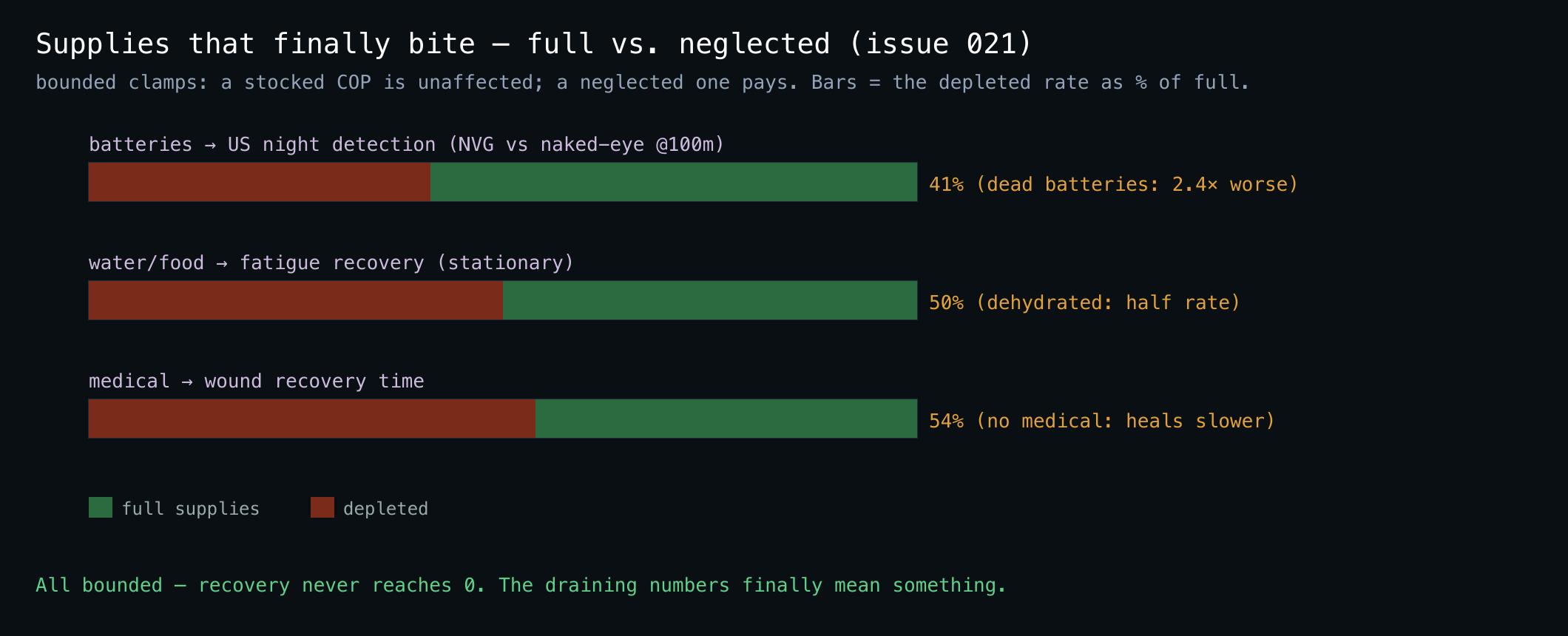
logistics-probe.ts). The bars are the depleted rate as a fraction of full — recovery never reaches zero (a bounded clamp), but a neglected COP is measurably worse off.| supply | coupling | full → depleted |
|---|---|---|
| batteries | US night-vision edge (NODs gate on the supply) | 2.4× night detection lost — naked-eye in the dark |
| water/food | fatigue recovery (a dehydrated, underfed soldier rests poorly) | 0.43 → 0.21 (50%) in 40 s stationary |
| medical | wound-recovery time (heals slower without supplies) | 54% of the full rate |
The night-vision one is the sharpest: NODs are why the US own the night here, and a patrol that lets its batteries run dry is, at a stroke, fighting the dark on the naked eye — a 2.4× detection penalty against a non-firing infiltrator at 50–250 m. The draining number on the supply screen finally means something.
smoke clean).Mechanism: lib/sim/combat.ts (nvg / hydration gates) · lib/sim/world/world.ts (supply factors, wound recovery). Oracle: scripts/logistics-probe.ts · finding: scripts/cop-defense-probe.ts. Raw record: docs/progress/2026-06-10-open-issues/021-cop-fortification/. The hesco/claymore combat-coupling is deferred with the measured standoff finding, not faked. Built by an autonomous agent fleet.