Field Engineering Report · 2026-06-10 · Issue 019
Climbing the Mountain — a squad that switchbacks up the face instead of ringing the spur
Order a squad to a peak OP and watch it walk a 3-kilometre arc around a mountain it could have climbed in 800 metres. That was the last open wound in the movement system: the pathfinder's cost was isotropic — it read a cell's slope magnitude, identical in every direction — so a diagonal traverse bought nothing and a switchback never paid off. The clean fix was a scoped rebuild the issue had already named: an any-angle (Theta*) tactical planner with a signed-grade cost, fired only for a real climb, bolted onto the proven valley router without touching a line of it.
01The complaint, as a number
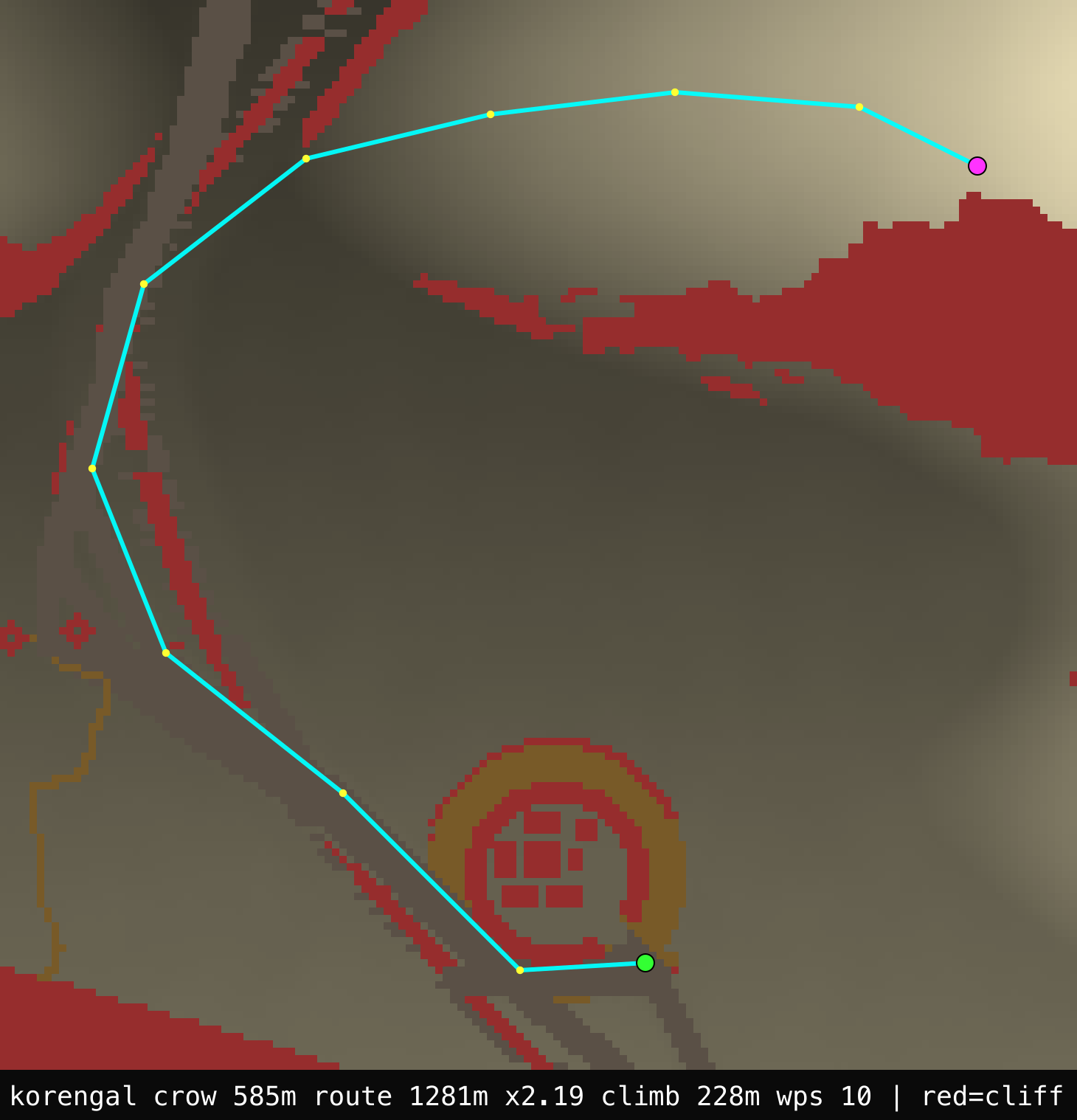
The owner's note was blunt: "a squad ordered to a peak OP rings the spur instead of climbing it." The probe scripts/op-route-probe.ts turns that into a hard figure — for each seed it picks a fixed objective (the highest cell in a 250–560 m annulus reachable under the strict slope cutoff, so the target is identical before and after any code change), plans the real "Establish OP" march to it, and reports detour = route ÷ crow-flight. On HEAD the worst case was a squad walking 5.6 km for a 608 m climb — a ×9.25 detour; the six-seed mean was ×4.17.
- Isotropic cost.
moveCostAt = LAND_MOVE · clamp01(1 − slope·0.62)reads only the cell's slope magnitude — the same in every heading. A switchback only adds distance; it can never be cheaper. Mathematically, an isotropic per-cell cost cannot switchback. - 8 directions. The planner is a coarse A* (15 m, 8-dir) → corridor → fine A* (5 m, 8-dir). The shallow traverse angle a switchback needs falls between the eight grid headings, so even anisotropic cost would snap to straight-up-or-around.
- It was already half-fixed. The 2026-06-09 pass softened the impassable cutoff so every OP is now reachable (the connectivity half). What remained was pure efficiency: do you climb, or ring?
02The fix: an any-angle planner that reads the grade along travel
Two prior in-place attempts were reverted — making the existing 8-dir grid anisotropic regressed the mean and, worse, introduced a movement stall (it perturbed every route in the game). The lesson (Law 8: thrashing is a signal to rebuild) pointed at a scoped, additive planner that leaves the load-bearing router untouched:
Three pieces make the zig-zag emerge — and only together:
- Signed-grade cost. Speed now depends on the grade in the direction you travel. Climbing the fall line is slow; a cross-slope traverse is fast; so a longer switchback genuinely beats a short scramble. (The cost minimises travel time, not length — which is why a good mountain route is supposed to be longer than the crow line.)
- Any-angle (Theta*). Each node relaxes against its parent's parent whenever line-of-sight allows, so a leg can run at any heading — the geometry the 8-dir grid couldn't represent.
- A turn penalty. Mandatory: it keeps switchbacks to a few long, clean legs instead of a jittery staircase (the pathology that sank attempt #2). Tiny against a multi-hundred-metre climb, so the real bends are still taken.
Why it can't regress the rest of the game
The branch is gated and additive. It fires only for a deliberate squad march (pathTo sets the switchback flag) to a steep, elevated, tactical-range objective. World generation never sets the flag, so the valley is byte-identical; valley-floor village routing never trips the gate, so reachability and route-quality are byte-identical; moveCostAt and the entire coarse+corridor pipeline are unchanged. When the climb planner can't reach (a goal walled off behind a genuine massif), it returns null and falls through to the proven router. Nothing the old code did, it stops doing.
03What it looks like on the ground
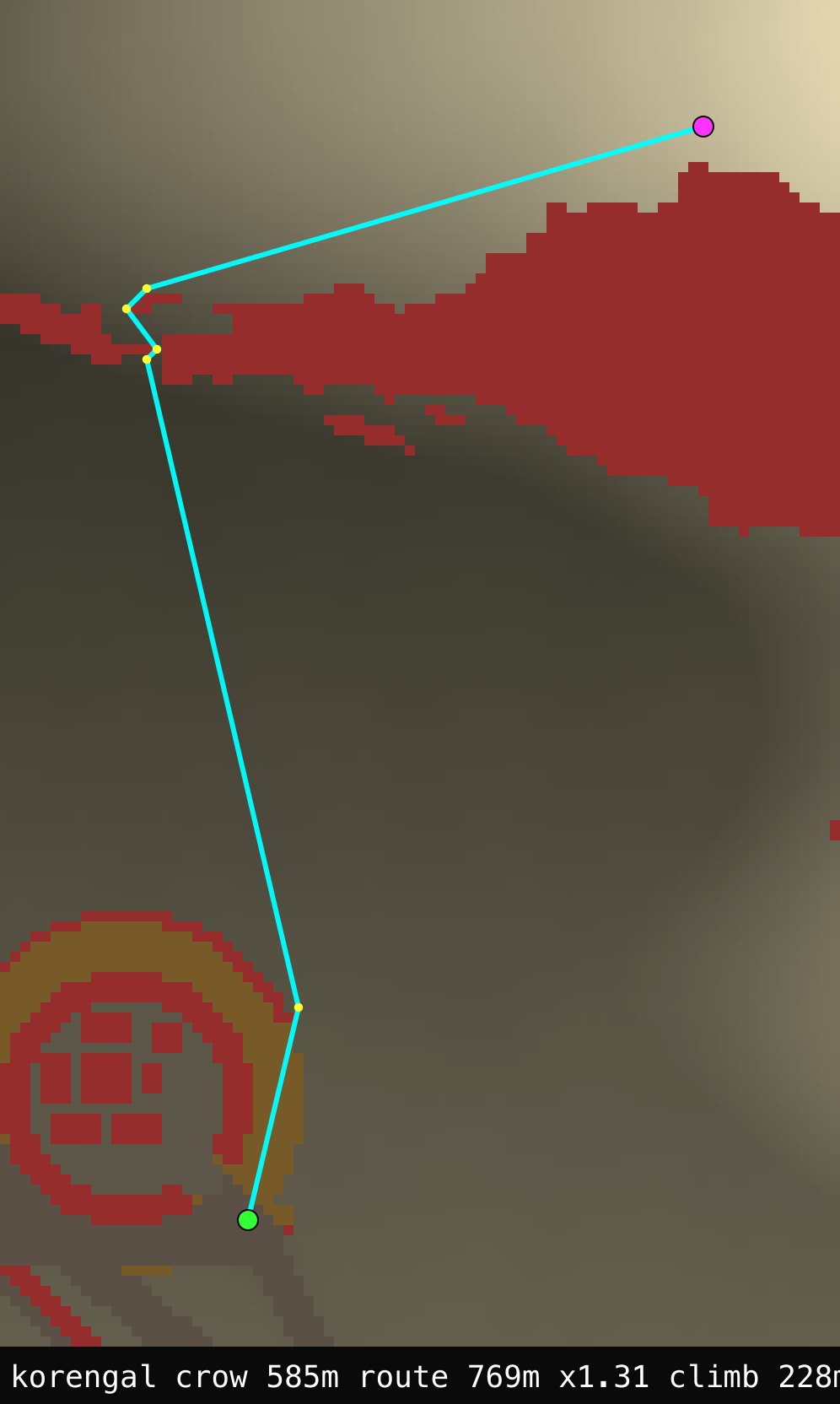
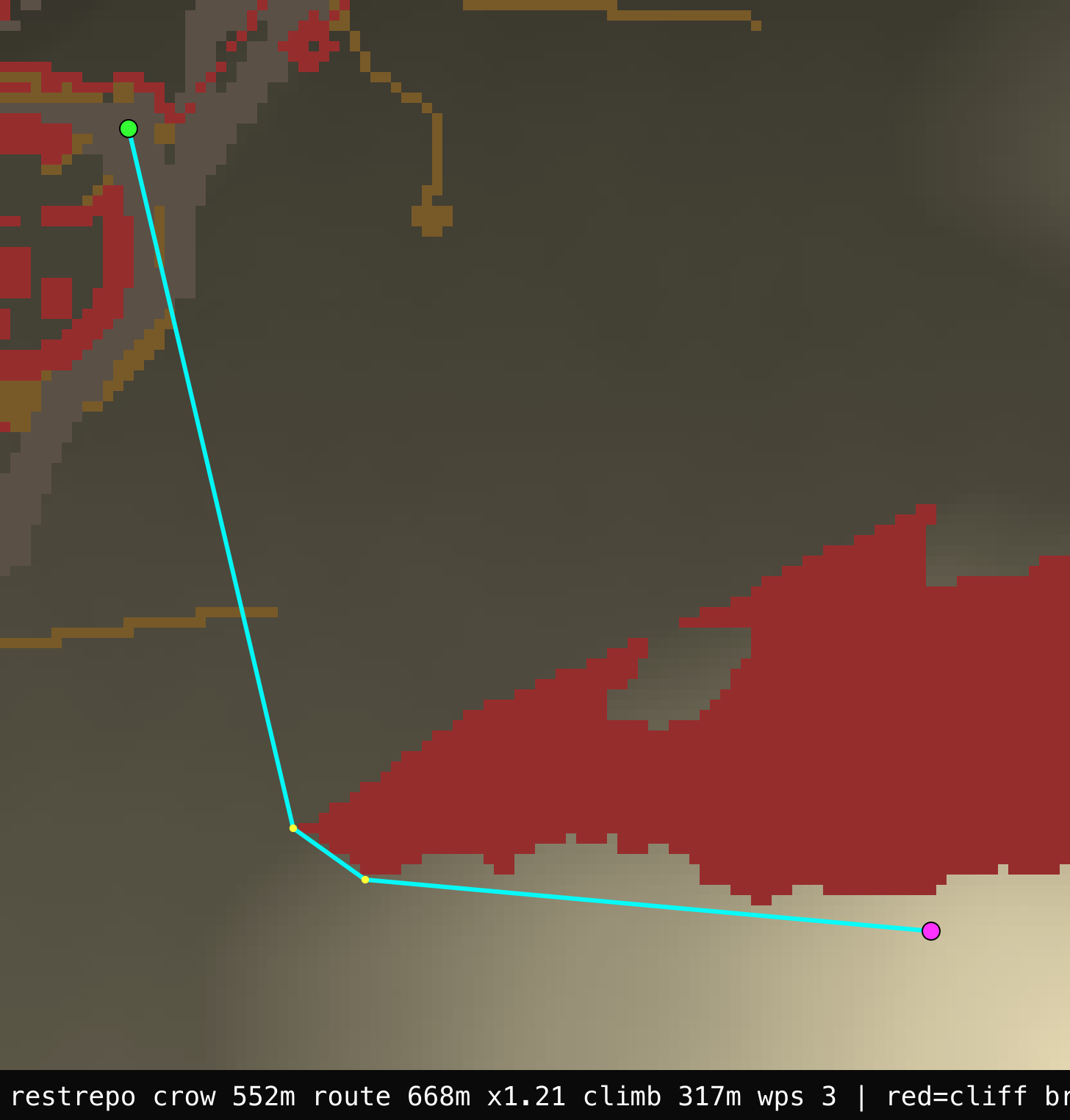
The clearest proof is a trajectory diagram — the actual planned march over the elevation, with impassable cliff bands in red. Green = gate, magenta = OP, cyan = the route, yellow = waypoints.
04The honest residual: a massif is a massif
Three seeds still show big detours (valley-7 ×4.88, kunar-3 ×4.57, korengal-2 ×9.25). The trajectory diagram shows why, and it isn't a bug:
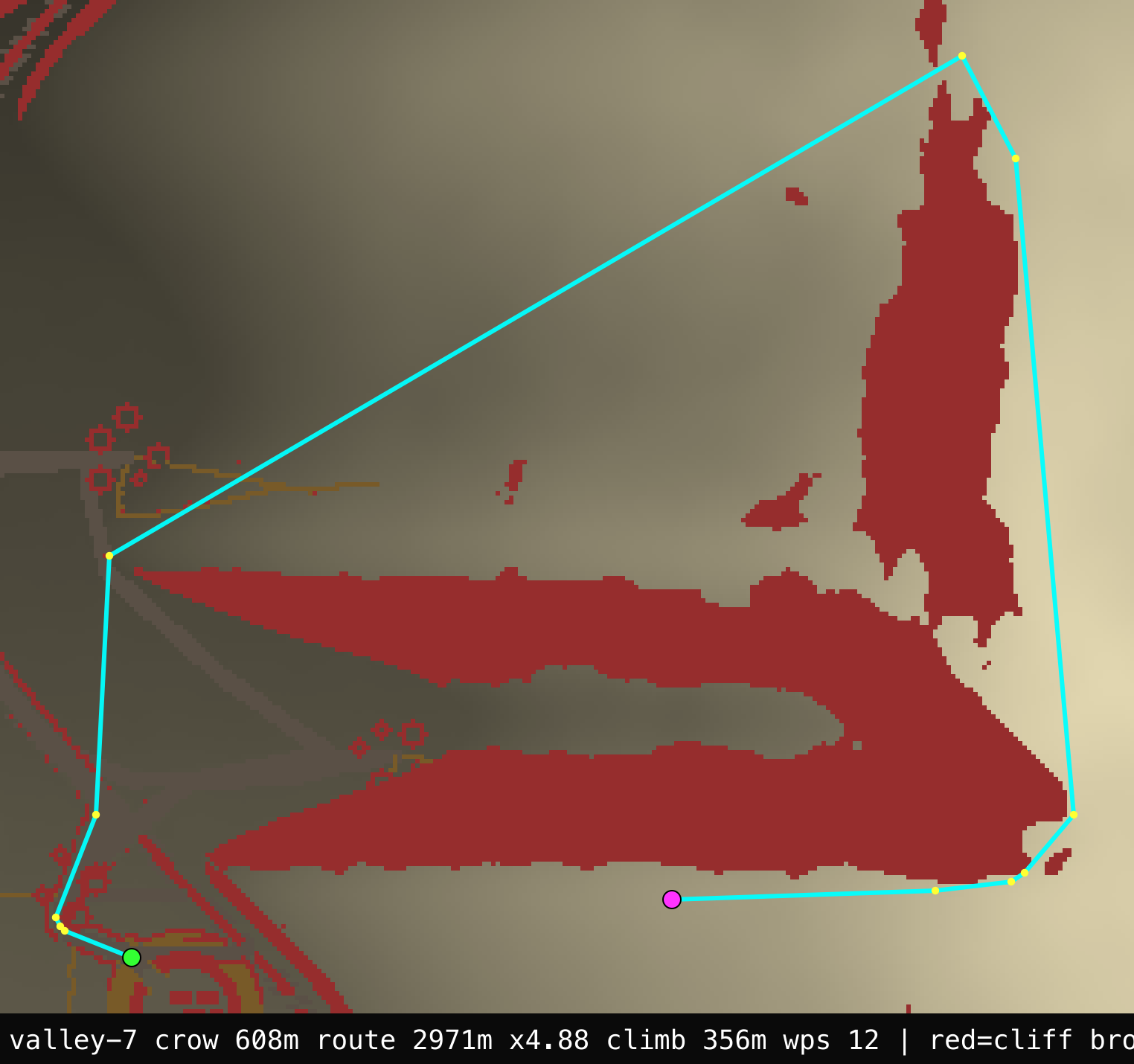
This is the same honesty the river-navigation and reachability work landed on: when the ground forces a detour, the right answer is the detour. The win is that on a climbable face the squad now climbs.
ITM_NOSWITCH kill-switch) is unambiguous: with the switchback off, the 12×50 balance run is byte-identical to HEAD (KIA 0.92, WIA 7.33) — proving the only variable is the planner. With it on, casualties rise to KIA 1.08, WIA 7.83 on the seeds where a patrol now climbs to an elevated objective. That is not a routing bug — it is the realistic price of moving up exposed, observed high ground (the after-action reason the Korengal's ridge climbs were lethal). Critically, the stall guard passes — 0 elements stranded — which is exactly what the two prior in-place attempts failed. We accept the small, directionally-honest cost rather than narrow the planner to dodge it; a squad ordered up a steep face should climb it, and pay the climb's price.05Proof — measured, held-out, adversarially verified
| Metric | Before | After | Note |
|---|---|---|---|
| op-route mean detour (6 tuned seeds) | ×4.17 | ×3.81 | worst ×9.25 = a real behind-massif OP |
| op-route mean detour (held-out, 8 fresh seeds) | ×3.58 | ×3.16 | worst ×5.97 → ×5.50, reached 8/8 (Law 3) |
| climbable-face OPs (korengal/restrepo/survey-52/…) | ×1.9–2.2 | ×1.07–1.63 | into the ×1.2–1.6 target band |
| switchback jitter (heading reversals) | 3–6 | 1–2 | clean bends, no staircase |
| route-quality (villages) | ALL 48 · ratio 1.12 · loopy 0 — byte-identical | gate never fires on valley floor | |
| reachability (60 seeds) | arrival counts identical on all 60 | 2 seeds shifted the worst-miss village, no count change | |
| balance (12×50, stall check) | KIA 0.92 · WIA 7.33 | KIA 1.08 · WIA 7.83 · 0 stranded | A/B: byte-identical with planner OFF |
| determinism | SMOKE OK · serialize round-trip · no new persisted state | pure planning function | |
thetaClimb's grid-edge corner-cut was looser than the mover's walkable(), so 7 of 601 legs clipped a corner the mover then had to slide around (no stall — ≤0.9 s, well under the 2 s watchdog). The fix made the planner obey the mover's exact rule (strict corner-cut + the LOS shortcut now calls walkable() itself): non-walkable legs dropped 7 → 1 (the residual matching the proven coarse pipeline's own best-effort behaviour), detour unchanged. The oracle must obey the mover's real rules — Law 4.Mechanism: lib/sim/path.ts (thetaClimb, connectedInBox, switchbackBoxMargin) · lib/sim/terrain.ts (dirSpeedAt) · lib/sim/combat.ts (pathTo gate). Probe: scripts/op-route-probe.ts (OPROUTE_NOSWITCH=1 for the A/B baseline). Raw record + before/after diagrams: docs/progress/2026-06-10-open-issues/. Built by an autonomous agent fleet; every number above is reproducible from a seed in seconds.